
 Deutsch
 English


AutoBLADE
Project manager: Hendrik Möllers
AutoBLADE – automated technology for the production of continuously draped preforms for large-area FRP infusion components with a high aspect ratio
Harnessing energy from tidal currents offers great potential for increasing the share of renewable energy in the energy mix of the future. The manufacture of rotor blades for the tidal power plants required for this purpose is characterized—just like the production of wind turbine rotor blades—by a predominant share of manual labor. This applies in particular to the preforming process step, in which a large-area textile preform is produced, which is then vacuum-infused with the polymer matrix in a subsequent step. While preforming for small and medium-sized components is typically carried out by pressing bonded textile layers, there is no automated counterpart for large-area components with a high length-to-width ratio (aspect ratio). If preforming for such FRP components can be automated, this holds the promise of both economic and quality-related manufacturing optimizations for sustainable energy production.
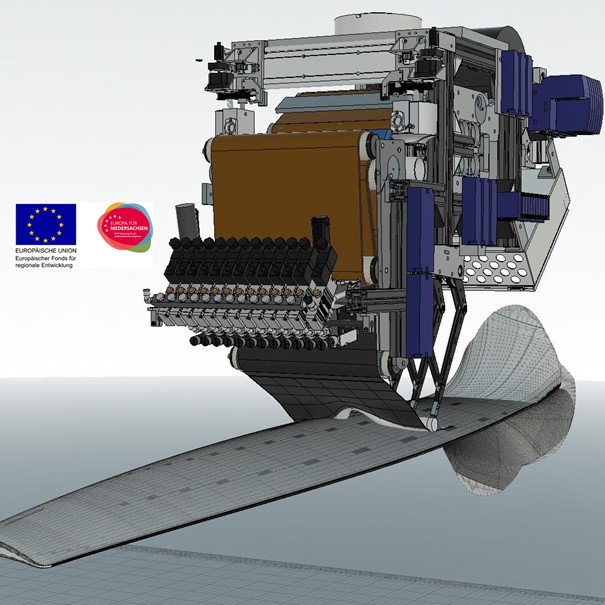
The goal of the research project, to be carried out by a consortium of the University of Leuphana (LU) Hannover, Clausthal University of Technology (TU Clausthal), and Braunschweig University of Technology (TU Braunschweig), is to develop and investigate an automated technology for the production of continuously draped preforms for large-area FRP infusion components with a high aspect ratio. The novel, fully automated manufacturing process—which is being developed using a technology demonstrator in the form of a rotor blade for tidal power plants—involves the layer-by-layer construction of a preform through the continuous draping of online-bonded textile semi-finished products onto complex curved surfaces.
With the help of the functional demonstrator of a draping head for complex structural components developed in the FlexProCFK project, a new technology for the continuous construction of a dry-fiber preform is being developed and researched. A key focus of this research is the fixation of the fiber fabric using a sprayed binder onto the mold or the previously laid textile layer to prevent slippage. The laying process is adapted to the activation behavior of various binder types, and the impact on the quality of the preform is investigated. Furthermore, the infusion behavior of the preform under the influence of the binder material and quantity is examined through permeability measurements and modeled for use in infusion simulations. In the technology demonstrator under consideration, manufacturing-induced deviations in fiber angles and wrinkling in the preform represent one of the most common causes of failure. Stereoscopic imaging of the fiber structure after placement captures the fiber angles and draping errors in the preform, serving as the basis for realistic infusion simulations and structural analysis to characterize the properties of the rotor blade. Simulations are used to investigate the influence of local fiber angle deviations on mechanical component properties such as strength and stability as a function of component geometry parameters and material properties. Through continuous exchange within the innovation network, the findings from the experimental and simulation studies are efficiently integrated and incorporated into process development to improve preform quality.
Duration: 2021–2022